How insulation affects heating bills is easy to see on a January statement. Heat leaves a poorly insulated house through the attic, walls, floors, and tiny air leaks, and your furnace or heat pump runs longer to replace it. This guide explains what insulation does, what savings are realistic, which R values matter in Tennessee, and what to fix first. Our home remodeling services team in Columbia checks attics, crawlspaces, and walls on every remodel, because opening a ceiling or wall is the best time to correct hidden energy problems.
If you are building new, a good custom home builder plans insulation and air sealing before the drywall goes up, when it costs the least to do right. For existing homes, the steps below show how to find the biggest gaps and what order to tackle them in.
Quick Takeaways
- Insulation slows heat loss, and air sealing stops heat from leaking around it
- How insulation affects heating bills is usually strongest in the attic, where heat escapes most easily
- ENERGY STAR savings figures are averages and estimates, not promises for your house
- Seal air leaks first, then add insulation
- The right R value depends on your climate zone and how much insulation you already have
How Insulation Affects Heating Bills
Heat always moves from warm areas to cold ones. In winter, that means warm air inside your home is constantly trying to reach the cold outdoors. Insulation resists that movement, and R value measures how well it does so. The higher the R value, the better the resistance.
Air leaks make the problem worse. ENERGY STAR notes that if you added up all the leaks, holes, and gaps in a typical home’s envelope, it would equal having a window open every day of the year. It also says that most homes in the United States do not have enough insulation and have significant air leaks.
Common signs your house is losing heat:
- Drafty rooms or cold floors, ceilings, and walls
- Uneven temperatures from room to room
- Heating bills that keep climbing
- Ice dams on the roof edge after snow
Estimated Savings From Air Sealing and Insulating
Homeowners want a number for how insulation affects heating bills, so here is what the federal government actually says. EPA estimates that homeowners can save an average of 15 percent on heating and cooling costs, or an average of 11 percent on total energy costs, by air sealing and adding insulation in attics, floors over crawl spaces, and accessible basement rim joists. Read the details in ENERGY STAR’s explanation of the estimated savings from air sealing and insulating.
Savings also vary by climate. ENERGY STAR’s estimates for the two zones that cover Tennessee look like this:
| Climate Zone | Estimated Savings, Total House | Estimated Savings, Heating and Cooling Only |
| Zone 3 | 8 percent | 14 percent |
| Zone 4 | 12 percent | 17 percent |
| National average | 11 percent | 15 percent |
Please treat these as estimates. They come from energy modeling of a typical existing home built between 1970 and 1989, so your own results depend on your home’s age, size, current insulation, and how it is heated.
Air Sealing First, Then Insulation
Many homeowners add insulation and see little change because air is still leaking through the same gaps. ENERGY STAR explains why air sealing and insulation work together: a well sealed envelope combined with the right amount of insulation makes a real difference on utility bills. EPA also recommends air sealing the attic before adding attic insulation.
Here is the difference between the two:
- Air sealing: Closes gaps around pipes, wires, vents, recessed lights, and attic hatches so conditioned air stays inside
- Insulation: Slows the heat that passes through ceilings, walls, and floors
Recommended R Values for Tennessee Homes
Most of Middle Tennessee falls in climate zone 4A, and Maury County lists Climate Zone 4A in its published design criteria. Some counties in the southwest part of the state fall in zone 3. Confirm your county on the climate zone map before you buy materials.
Here are ENERGY STAR’s recommended insulation R values by climate zone for retrofitting existing wood framed homes:
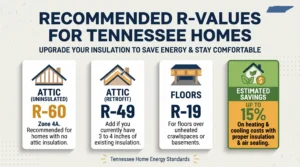
| Climate Zone | Attic, if Uninsulated | Attic, if 3 to 4 Inches Exist | Floor |
| Zone 3 | R49 | R38 | R19 |
| Zone 4A and 4B | R60 | R49 | R19 |
These levels are based on the 2021 International Energy Conservation Code, and local codes may differ. For walls, ENERGY STAR suggests adding insulative sheathing whenever siding is removed.
Types of Insulation and Where They Work Best
No single type is best everywhere. ENERGY STAR’s guide to choosing the appropriate insulation type groups them by use and skill level.
| Type | Best Suited For | Skill Level |
| Batts and rolls (fiberglass, mineral wool) | Unfinished walls, floors, and ceilings | Basic |
| Loose fill and blown in (cellulose, fiberglass, mineral wool) | Existing wall cavities, new wall cavities, unfinished attic floors | Intermediate |
| Foam board (EPS, XPS, polyiso) | Unfinished walls, floors, exterior continuous insulation | Intermediate |
| Sprayed foam | Wall cavities, attic floors and ceilings | Advanced, certified installer needed |
R value per inch differs by product and by how well the material is installed, so ask your installer for the installed R value in writing instead of comparing thickness alone.
Where Heat Escapes in Tennessee Homes
Knowing where the heat goes explains how insulation affects heating bills in your own house.
- Attic: Usually the biggest opportunity, since warm air rises
- Crawlspace and floors: Cold floors often signal missing insulation or air leaks below
- Walls: Harder to fix, but easy to address during remodels or siding replacement
- Windows and doors: Gaps around trim leak air even when the glass is good
- Ducts in unconditioned spaces: Leaky or uninsulated ducts waste heated air
Insulation and Home Additions
An addition has to be insulated to the energy code, and the connection to the old house matters as much as the new walls. Air leaks often hide where new framing meets old. Our planning guide to home additions in Columbia, TN covers permits, Maury County design numbers, and the steps from drawings to final inspection. When you plan a room addition, ask how the insulation, air sealing, and heating and cooling will be handled together, since that is where how insulation affects heating bills shows up first.
Insulation in a New Home
Building new gives you the best chance to get this right. Insulation goes in after framing and rough in work and before drywall, and some counties inspect it. For example, Williamson County lists an insulation inspection for new single family dwellings. If you are planning a new build on your land, talk with your builder about wall, attic, and floor insulation targets before plans are final, because it is far cheaper to add insulation in an open wall than later. Timing matters too: see our guide on when to start building a house to plan how the seasons affect your schedule.
DIY or Contractor?
ENERGY STAR calls attic insulating a moderately difficult do it yourself project, but it recommends bringing in a professional if you find any of these:
- Difficult attic access or very limited working space
- Wet or damp insulation, which can mean a leaky roof
- Moldy or rotted rafters or joists
- Bathroom, kitchen, or dryer vents exhausting into the attic
- Little or no attic ventilation
- Old knob and tube wiring
- Vermiculite insulation, which may contain asbestos and should not be disturbed until it is tested
How to Choose an Insulation Contractor
- Verify the license using the state’s contractor license verification in Tennessee resources
- Ask for proof of insurance and local references
- Request a written scope that lists each area, the target R value, and the air sealing included
- Ask whether air sealing happens before insulation
- Review finished work, such as our completed homes
The National Association of Home Builders also shares NAHB homeowner resources on remodeling and choosing a builder.
Frequently Asked Questions
Q: How much can insulation lower my heating bill?
A: ENERGY STAR estimates that air sealing plus insulation saves an average of 15 percent on heating and cooling, or about 17 percent in climate zone 4. Your actual savings depend on your home and how you heat it.
Q: What attic R value do I need in Middle Tennessee?
A: ENERGY STAR recommends R60 for an uninsulated attic in zone 4A and R49 if you already have 3 to 4 inches of insulation. Zone 3 counties use R49 or R38. Check your climate zone map before choosing any materials.
Q: Should I air seal before adding insulation?
A: Yes. EPA recommends sealing attic air leaks before adding insulation, because leaks let heated air bypass the insulation. Sealing first helps the new insulation work the way its R value says it should.
Q: Is spray foam better than fiberglass or cellulose?
A: Each fits different jobs. Sprayed foam needs a certified installer, while batts and blown in types are common for walls and attics. The best fit depends on the space, access, moisture, and your budget.
Q: How do I know if my attic needs more insulation?
A: Look for drafty rooms, uneven temperatures, rising bills, or ice dams. Then measure your insulation depth and compare it with the recommended R value for your zone. A professional energy audit can confirm it.
Final Thoughts
How insulation affects heating bills comes down to two things: how much heat your home holds in and how much air sneaks through the gaps. Start with air sealing, add the R value that fits your climate zone, and give the attic first priority. Savings are estimates, but comfort improvements are often noticeable right away. Ready to talk about your home? Call AMC Construction at 931-416-5131 or request a free estimate today. Tennessee General Contractor License 82787.

Luxury Custom Home Building in Franklin, TN
Building a luxury residential property from scratch remains one of the most rewarding milestones a property owner can ever achieve. Partnering with a dedicated custom home builder in franklin tn ensures your specific design ideas transition smoothly into a stunning real estate asset. At AMC Construction, we specialize in constructing elite private estates, upscale architectural […]

Water Damage Restoration in Columbia TN
Water damage is one of the most stressful issues homeowners face. In Columbia TN, heavy rains, flash floods, and plumbing leaks are all too common and the longer water sits in your home, the more damage it causes. What may start as a small leak can quickly escalate into structural issues, mold growth, and expensive […]

Home Improvement Contractor Columbia TN
Your home is your biggest investment—and in a place like Columbia, TN, where weather shifts dramatically across seasons, maintaining the outside of your home is just as important as updating the inside. From roofing and gutters to siding and driveways, working with a reliable home improvement contractor in Columbia TN can save you money, boost […]